


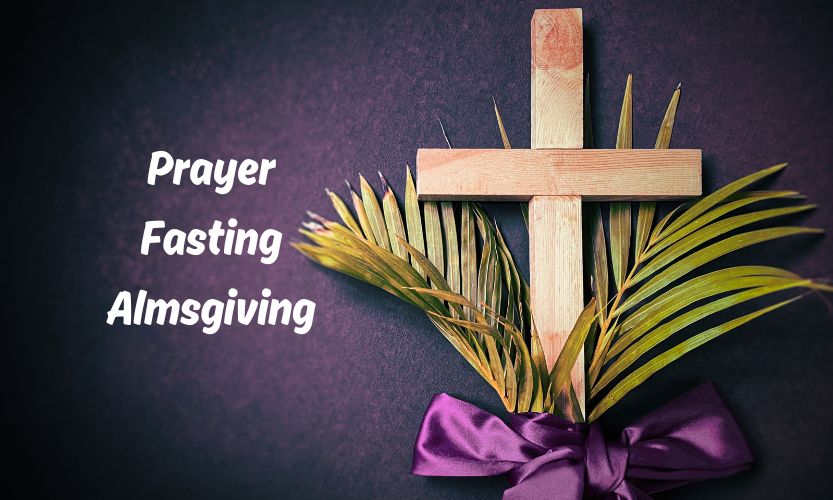
LENTEN MEDITATION:
VI. THE PASSION OF CHRIST
LENT is the journey of penance and penances to Holy Week, to the celebration of the great mystery of our faith: the passion, death and resurrection of the Lord. Before conversing on the Passion pf Christ, we have to say a word on the total Christ – from his birth to the ascension into heaven.
Jesus’ question to his disciples – to each one of his followers – is constantly present in the lives of all Christians: “Who am I for you?” (See Mt 16:13-17). We may answer the question objectively and subjectively.
THE NATURE OF CHRIST
The objective answer is easy. “Who are you, dear Jesus?” “You are our Savior, our Redeemer, the Way, the Truth, the Life, and the Light...” “You are the Good Shepherd, the Good Samaritan, the Santo Niño, the Nazarene, Eucharistic Bread and Wine, the Sacred Heart...” Jesus is the Son of God and the Son of Mary, a human being like us, but without sin: “And the Word was made flesh and dwelt among us.” The objective answer to the question - who is Christ for his followers - is necessary and bases and feeds always the subjective answer.
Jesus, however, is looking for our personal answer that comes not from books, but from a loving encounter with the Lord who lives in us. Christianity does not mean “reciting a creed; it means, knowing a person” (cf. W. Barclay). To know the Lord implies “personal encounter with him, intimate experience, loyalty, love, adherence to the person, doing his will” (López Melús, Desierto).
Jesus is the same yesterday, today and always, and the same Christ in all cultural expressions.
THE PASSION OF CHRIST.
As disciples of Jesus Christ, let us contemplate the suffering Christ, the crucified Lord. What is the meaning of the Passion of Christ for us?
Before the Blessed Sacrament, we pray often: O Sacred banquet, in which Christ is received, the memory of his Passion is recalled, the soul is filled with grace, and a pledge of future glory is given to us. The memory of his Passion is recalled!
We remember Mel Gibson’s acclaimed film The Passion of the Christ. For some, the film is a bit too much: too much blood from Jesus. For many others – for us -, the film is very close to reality, the dark reality of the passion and death of Jesus. Mel Gibson explains: “The passion of Christ is very strong. We are accustomed to see beautiful crucifixes hanging on the wall, and we say Jesus was scourged, carried his cross on his shoulders and then nailed on the wood of the cross … Through my childhood, I did not understand how that happened. The profound horror of what He suffered for our redemption did not shock me. To understand what He suffered, also at the human level, makes me feel not only compassion, but also the debt I owe him. I want to compensate him for the immensity of his sacrifice.”
We firmly believe in Christ: in Christ Crucified. To believe in God crucified is to recognize God in Christ crucified (J. Moltmann). Why the Only Begotten Son of God is crucified and dies on the cross? God could have delivered us through his divine will!
Why Jesus’ death on a cross, which is a most humiliating way of dying? "There was no other more suitable way of healing our misery than by the Passion of Christ” (Thomas Aquinas). Why? Christian Tradition provides us with four main reasons.
(1) In the first place, because through his passion and his crucifixion, Jesus shows us his infinite love: “God so loved the world that He gave his only begotten Son” – to save it, to save us all (cf. Jn 3:16).
(2) In the second place, because Christ by dying on the Cross reveals to us the gravity of sin and our need of a Savior. Jesus dies on the cross to atone for the sins of humanity, and to show us the evilness of sin and thus it helps us not to commit sin: “He himself bore our sins, so that freed from sins, we might live for righteousness” (I Pet 2:24).
(3) In the third place, by His Passion Christ delivered us not only from sin, but also merited for us sanctifying grace which makes us children of God and leads us to the glory of happiness: “Christ redeemed us from the curse of the law by becoming a curse for us” (cf. Gal 3:13); ”Christ came so that we could be justified by faith… For in Christ Jesus, you are all children of God” (Gal 3:24, 26).
(4) Finally, and in the fourth place, through his passion, Jesus gives us an example to follow. We know that He is our Way, which includes necessarily the Way of the Cross. St. Peter says: "Christ also suffered for you, leaving you an example that you should follow in his steps” (1 Peter 2:21). His passion is the model for all virtues, in particular - according to St. Thomas - charity, patience, humility, obedience, and contempt for earthly things.
The sufferings of Christ, who is the suffering servant of the prophet Isaiah, were incredible: his agony in the garden, the betrayal of Judas, the abandonment by his disciples. Moreover, he is accused falsely, condemned unjustly, mocked, ridiculed, and scourged at the pillar. And thereafter, the way to Calvary bearing a heavy cross, his crucifixion and death on the a cross. Through it all: the admirable serenity of Jesus, his sounding silence, his forgiving love, his obedience to God the Father.
The saints love to contemplate Jesus nailed to the Cross! A wooden crucifix presiding the main altar of a chapel removes the nail on his right hand to embrace St. Bernard. Christ on the cross in San Damiano asks Saint Francis of Assisi to restore his Church. The St. Thomas had a mystical experience before the crucified Lord. The preferred book of Saint Catherine of Siena was Christ’s death on the cross. St. John of the Cross, for whom the cross is the staff for the journey of life, heard from a painting of Christ carrying the cross these words: “You have done a lot for me, what you wish from me?” St. John XXIII writes in his Journal of the Soul: “My great book, from which I must draw with great care and affection, the divine lessons of high wisdom, is the crucifix.”
How may we respond to the passion and cross of Jesus? We are authentic followers of Christ, true disciples if we follow him carrying our personal cross: “If anyone wants to be a follower of mine, let him renounce himself and take up his cross and follow me” (Mt 15:24). We try hard to carry our own cross patiently, prayerfully, and - if possible - joyfully, with the spiritual joy that radiates in the life of the saints. Thus, we preach, like St. Paul, a Crucified Jesus (cf. 1 Cor 1:22-24), who is also our Risen Lord.
We are Disciples of Christ and long to be intimately close to him and to those who are close to him, and also to God’s creation (cf. Gen 1:31; Mt 6:28-29). Jesus identifies himself with those crucified on earth. Where are we when our brothers and sisters are crucified today? Like the Good Samaritan, we are asked to help the wounded on the roads of life, and like Simon Cyrene, to offer our shoulder to those being crucified today carry their heavy cross. We have to practice love for the needy and poor, who are for us Christ carrying his cross today: “I was hungry, and you gave me food; I was thirsty and you gave a glass of water; I was a stranger and you welcomed me” (Mt 25:35). Jesus is the poor person: “This is me, love me! How radical and how simple” (Henri Nouwen).
Meditating on the Cross of Christ, another question comes to our mind: Where are we, when they crucify our Lord, when others are crucified today? And we also hear the recurring questions from our brothers and sisters – and nonbelievers: Why there is so much suffering in our world? Why do innocent children suffer? Where is the merciful God? The mystery of evil is linked to the mystery of God – yes, of an omnipotent and merciful God! We know that God loves us, He is Love, and that the only answer we have to those intriguing questions is Jesus on the cross: Jesus, the Son of God, is the Crucified Lord! “In the love of the crucified Lord is God himself identified with all who suffer, shouting against all the injustices, and forgiving the executioners of all times” (J. A. Pagola).
Difficult to carry our cross, difficult to help others carry their heavy cross, difficult to aid the wounded on the roads of life? It is not easy. God’s never fails us. We need to pray for God’s help always. Therefore, “Never leave prayer. There is always remedy for those who pray” (St. Teresa of Avila).
We need to pray, to be strong. We are weak, we are sinners. Best vitamin: prayer. Best weapon: love, merciful love. Hence, “Put love where there is none, and you will reap love” (St. John of the Cross).
We thank you, Lord, for your wounds, for your cross, for your death: for your love We love you, Lord; we are sorry for offending you and others, and creation. We ask you, humbly and prayerfully, for your continuing grace and mercy. (FGB)