

LENTEN MEDITATIONS:
II. PRAYER, FASTING AND ALMSGIVING
FAUSTO GOMEZ OP
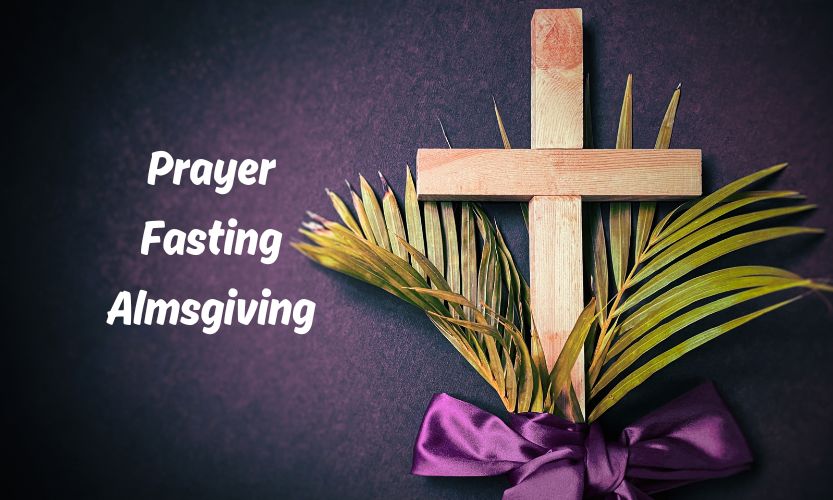
In the Sermon on the Mount, Jesus invites his followers to perform the three habitual practices of penance of the Jews: prayer, fasting and almsgiving (cf. Mt 6:2-7, 16-18). From then on and up to now, the three penitential practices have become for Christians the traditional and classical practices, particularly, of the liturgical season of Lent.
THE VIRTUE OF PENANCE
The radical goal of Lent is to be closer to Christ, to the Crucified and Risen Lord; to let Christ rule our lives: “It is Christ who lives in me” (St. Paul). The goal is to become more deeply an authentic disciple, that is, to be “constantly ready to bring the love of Jesus to others” (Evangelii Gaudium, 127). To be able to bring Jesus’ love to others, we need to possess his love and for this to happen, we need to be repentant. Lent is the appropriate time to be deeply sorry for our sins, to receive the pardon and love of God and, in turn, to give to others our pardon and Jesus’ love.
Saint John XXIII writes in his diary: There are two paths to paradise: innocence and penance. We have lost our innocence, so the path open to us is penance. Lent is the journey of penance to the celebration of the great mystery of our faith. Lent is “a favourable time to prepare to celebrate with renewed hearts the great mystery of the Death and Resurrection of Jesus” (Pope Francis, Lenten Message, 2020).
Connected with the cardinal virtue of justice, penance is a great virtue: a good operative habit or strong disposition of the soul that inclines the possessor to perform acts of penance. Penance is ordered to the destruction of sin as an offense against God, ourselves, neighbour, and creation.
The virtue of penance is a permanent attitude of Christian life. Lent is the special season of penance. Through 40 days Christians are asked by their faith, by Mother Church to practice in a deeper way the good habit of penance, which is mainly interior penance cantered on repentance: a firm disposition of the soul to renounce sin and return to God, a permanent inclination to change our lives following the way of Christ, the way of his life, death and resurrection. The virtue of penance renews our hearts, our loves.
The basic penance is greater fidelity to our vocation and mission. “If you just are what you ought to be, you will set the whole world on fire” (St. Catherine of Siena). The Constitution of the Dominicans says: Imitating St. Dominic…, the brothers should practice the virtue of penance especially by observing faithfully all that belongs to our life. For the Dominican family, for all the Disciples of Christ really, the principal forms of penance are: the performance of spiritual exercises, works of mortification or self-denial, and works of benefit to the community.
On the journey of Lent, Pope Leo XIV recommends to us to cultivate listening (to God and to the needy), to fast by disarming our language (diminishing hurting words and increasing the space to listen to the voice of others), and to be united (thus contributing to building the civilization of love). (Lenten Message, 2026)
PRAYER, FASTING AND ALMSGIVING
Interior penance, “the habit of the heart,” inclines us to perform external penances, which in turn deepen penance, repentance in our hearts.
The virtue of penance as continuing conversion disposes us to practice, in particular, the traditional penances of prayer, fasting and almsgiving. These penances help us re-establish and fortify our relationship with God through prayer, with ourselves through fasting and abstinence, and with others through almsgiving or mercy.
The Fathers of the Church, pre-eminent representatives of Christian Tradition, speak powerfully of the three classical expressions of penance, namely, prayer, fasting and almsgiving. For the Fathers of the Church, prayer is presented as directed to fasting and almsgiving. St Cyprian (200-250) speaks of fruitful and fruitless prayer. Prayers that produce no fruits are prayers without good deeds: “Prayer with no good works is not effective. Prayer is good with fasting and almsgiving. For He who on the day of the last judgment will reward good works and almsgiving, today also listens favourably to prayers which come from good deeds.”
Fasting to be a good deed must be accompanied by almsgiving or mercy. Fasting without almsgiving is useless on the way to heaven. It is insufficient as John Chrysostom, Ambrose and Augustine tell us. St. Peter Chrysologus (406-450) writes: “Prayer, mercy and fasting constitute one thing only,” and they fertilize each other. Fasting is the soul of prayer, mercy is the lifeblood of fasting… They cannot be separated. So, if you pray, fast; if you fast, show mercy; if you want your petitions to be heard, hear the petitions of others… He who does not fast for the poor fools God. Give to the poor and you give to yourself.”
Today we need a new expression of fasting: technological fasting to fight technological addition. This needed kind of fasting contributes to having more interior silence, “prayer in secret”- as Jesus recommends to us. In silence, we may hear God’s voice.
Fasting is not just abstinence from food and drink, but mainly abstinence from sin. It is manifested in the practice of sobriety and austerity to be able to have – as St. Augustine says – the body under the spirit, the spirit under God; and the passions under the will, and the will under God’s will.
We are pilgrims on the way to eternal life. On the way to happiness, to holiness, to the joy of Easter, three things are essential, namely, prayer, fasting and almsgiving. Fray Luis de Granada (1504-1588) explains that we do need the three in our lives: Prayer because it connects us with God; fasting or mortification because it puts order in our lives and almsgiving because it connects us with our neighbours, in the first place with the needy and poor. Penance, we may add, also connects us with God’s creation that we have to care and cultivate and not exploit or destroy.
ALMSGIVING AND FORGIVING
The Lord says: “Forgive, and you will be forgiven; give, and it will be given to you” (Lk, 6:37-38). Compassion or mercy – an effect of charity, with peace and joy - is the most important virtue in relation to others. Mercy comprises not only the corporal work of mercy but also the spiritual work of mercy. Thus, St. Isidore of Seville (c. 560-636) speaks of two kinds of mercy: corporal, or to give to the needy what you can; and spiritual, or to forgive the one who offends you. St. Isidore comments: the first, that is the corporal work of almsgiving, is practiced with the indigent; and the second, that is the spiritual work of forgiving others, is practiced with sinners. Thus, he ends, “you will always be able to give something: if not money, at least forgiveness.”
What is the kind of penance, of fasting that the Lord wants us to do? The Lord keeps answering us through his prophet Isaiah: God wants a fasting that breaks the fetters of injustice, that shares food with the hungry, that brings to your house the unsheltered needy, that clothes the man you see naked, and does not turn away from your own kin (cf. Is 58:6-7).
In this context, we remember Jesus’s parables of the rich man and poor Lazarus (cf. Lk 16:19-31) and of the last judgment (cf. Mt 25:31-46): I was hungry and you gave me food…
May prayer, fasting and almsgiving deepen the virtue of penance in our hearts and lead us to approach the Sacrament of Penance or Reconciliation. The virtue of penance entails “The will to receive the Sacrament of the forgiveness of sins” (K. Rahner), our sins against God, ourselves, neighbours, the poor neighbour, and creation. (FGB)