

ST. THOMAS AQUINA: MASTER, MISTYC, POET
IS HE STILL RELEVANT TODAY?
THOMAS AQUINAS (1225-1274) was born in Roccaseca, Italy, about 1225. He studied with the Benedictine Monks. Thomas is a young boy, between 7 and 9 years of age. He was then studying with the Benedictine monks of Monte Cassino. One day his teacher asked him: “Thomas, what do you dream?” The boy answered quickly: “I look for God, master, “Quid est Deus?”
WHO IS THOMAS AQUINAS?
After celebrating Mass (Macau, January 28, 2021) with the Missionaries of Charity of St. Teresa of Calcutta, the good superior commented to me, “I know two things on St. Thomas from my Novitiate: That he was stout and that once the family placed a woman of ill reputation in his room to tempt him.”
When Thomas was around 14 years old, he studied at the University of Naples. Five years later, in 1244, at 19, he joined the Dominican Order against the wishes of the family. (This the reason for: “the woman of ill reputation”) In 1248, he went to study to Cologne, where he studied under Albert the Great, completed his studies, and was ordained to the priesthood. His students called Thomas “a dumb ox”. Albert told them: “You call this man a dumb ox, but I tell you that the time will come when the bellowing of his doctrine will be heard to the ends of the earth.” At about 28, he went to Paris, taught at St. Jacques and later became professor of theology at the University of Paris. Later on, he taught in different cities of Italy (Anagni, Orvieto, Rome, Viterbo). He was a prolific writer.
Chesterton writes that “The Angelic Doctor produced books enough to sink a ship or to stock a library.” After having written 34 volumes in IV “major” and two columns, Thomas had a special encounter with Christ, a vision of God, which prompted the theologian to utter humbly: “All that I have written is straw.” It was on December 6, 1273 during the Mass of St. Nicholas in the Church of St. Dominic in Naples. After this vision, just a few months before his death, Thomas did not write anything more and even abandoned the instruments of writing.
This outstanding Dominican of the 13th century is – as Vatican II says - a special master (OT, 16) and guide (GE, 10). The latest Popes have presented Thomas in various ways. Pope Paul VI, as “apostle of truth” and “light for the Church and the whole world.” Pope John Paul II, as “master of thought and a model of the right way to do theology,” Pope Benedict XVI, as “master in harmonizing faith and morals” and “outstanding model for theologians.” Pope Francis says that Thomas articulated in a magisterial way the rational reflection on faith and its content.”
Furthermore, the great theologians of our time, including Rahner, Chenu, Congar, Schillebeeckx, Gustavo Gutierrez, Clodovis Boff, Felicísimo Martinez, Niceto Blazquez, etc; all highly recommend to all students of philosophy and theology the Universal Doctor Thomas Aquinas.
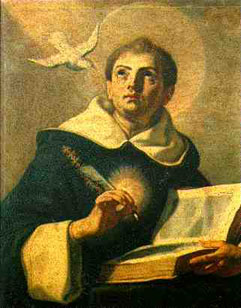
The Doctor of Divinity had three loves: the crucifix, the Eucharist and prayer (Jean-Pierre Torrell). He is not only a great philosopher and theologian, but also a saint , a poet and a mystic: How was he able to write the awesome and sublime hymns to the Holy Eucharist!
Thomas was a man of prayer, a contemplative man. In his life, there was no opposition but integration between prayer and study, contemplation and action: Contemplata aliis tradere (see STh, II-II, 181, 3). He was very devoted to the Holy Eucharist and celebrated one Mass and heard another Mass daily. He was very devoted to Our Mother Mary. (At margins in his Summa Contra Gentiles, we find repeatedly written Ave Maria.) Also devoted to the angels about whom he wrote incredibly well. Thomas was also devoted to the saints and in particular to St. Agnes. He read every day a chapter of the Collationes (Conferences) of Casiano, “to maintain alive in his heart the fire of devotion and the love of God.”
Throughout his life, The Angelic Doctor had a single commitment, that is, the unshakeable and uncompromising commitment to search for the truth. Indeed, he was lover of truth only! Every truth, he wrote, “regardless of who said it, comes from the Holy Spirit.”
Thomas was canonized by John XXII in Avignon on July 18, 1323. He was declared Doctor of the Church by Pius V in 1567. Aquinas was named Patron of Catholic Schools by Pope Leo XIII. The Church has given him various significant titles, including Angelic Doctor, Doctor of the Church, Common Doctore, Doctor of Divinity, Universal Doctor, and Doctor of Humanity. His distinctive sign: the sun, because, according to Pius XI, “while he gives the light of science to the intellects, he lights up the wills with the flame of virtue.”
Certainly, the Angelic Doctor is not – and should not be considered - “the exclusive doctor” of the Church: there are in all 38 doctors of the Church, including the incomparable St. Augustine and the marvelous St. Teresa of Ávila. St. Thomas’ way of doing philosophy and theology is a way open to all, conversing with all, and learning from all. We recommend to study St. Thomas – always enlightening - not to repeat him but to re-create him in our time.
A great theologian of the 20th century, Yves Congar, writes: “St. Thomas is a master of thought, a model of loyalty and intellectual honesty, a man of dialogue, the symbol of open-mindedness, and the genius of reality. We should remain faithful to his spirit… St Thomas is proposed as a master [by Vatican II]. This does not mean simply repetition and the exclusion of other theologians. Rather it means that we study under his guidance; we follow his spirit.”
Every year some works on St. Thomas are published. The year 2025, at least three important books in Spanish can be seen in libraries in Madrid. One entitled Tomás de Aquino. Una mirada inspiradora del erudito, poeta y santo para nuestro presente (2025), by Oliver Keenan. (The original in English: Thomas Aquinas) The second: La filosofía de Santo Tomás. Un esbozo (2025), authored by Stephen L. Brock. T. (Original in English: The Philosophy of St. Thomas. A Sketch), The third, by Felicisimo Martinez (2025) with the title: Espiritualidad debajo de la teología en la Suma Teológica de Santo Tomás de Aquino (2025).
Thomas Aquinas: humanist, philosopher, theologian, saint, poet and mystic continues to be important and significant today, in particular for philosophy, theology, and spirituality. The Angelic Doctor had one love only, namely, truth: the Truth to be known, to be loved and to be lived.
The goal of the theology of Saint Thomas, of his moral/ spiritual theology is not mainly knowledge on holiness but a holy life. Its ultimate goal is he beatific vision of God, who is the Holy One, who keeps inviting women and men to share in his divine holiness – to make us holy. The friend of St, Thomas, St. Bonaventure writes: “Theology exists to serve contemplation and to make us holy; however, its first purpose is to make us holy.” Theologian Torrell, expert on St. Thomas’ theology and spirituality comments: “The practice of theology, in particular for t]he Common Doctor of the Church, must cause the theologian [and all Christians and believers] to grow in holiness – to be holy. In the end, Prius vita quam doctrina: First life, then doctrine. (FGB)