Our Lady of the Rosary Province of the Order of Preachers
  • Home
    • History
    • Provincial Curia
      • Novitiate
      • Studentate
    • Vicariates & Missions
      • Mission in Taiwan
      • Mission in South Korea
      • Mission in Singapore
      • Mission in Timor Leste
      • Mission in Myanmar
      • Vicariate of Philippines
      • Vicariate of Japan
      • Vicariate of Venezuela
      • Vicariate of Spain
  • Officials of the Province
  • Dominican Saints
    • Saint Dominic de Guzman
  • Vocation
    • Religious Life
    • Formation

Select your language

  • Español
  • English (United Kingdom)
LENTEN MEDITATIONS: 1.	THE PILGRIMAGE OF LENT: CONVERSION, PENANCE, AND RECONCILIATION
Featured

LENTEN MEDITATIONS: 1. THE PILGRIMAGE OF LENT: CONVERSION, PENANCE, AND RECONCILIATION

LENTEN MEDITATIONS:

1.        THE PILGRIMAGE OF LENT: CONVERSION, PENANCE, AND RECONCILIATION

    FAUSTO GOMEZ 0P

The word “lent”, we are told, derives from an old English word “Lenten,” which means springtime. On the other hand, the Latin word “Lente” means going slowly. Based on this double etymology, “Lent signals the onset of spring and invites us to slow down our pace, to gather our thoughts, as it were, to take stock of our lives, to begin once again, to put things in their proper perspective” (Richard McBrien).

In his simple and beautiful Lenten Message (February 5, 2026), Pope Leo XIV invites us to cultivate listening, to fasting by not using hurting words, and to unity among us: listening, fasting, together.

The journey of Lent goes through conversion and penance to reconciliation.

CONVERSION

Jesus started preaching thus: “The Kingdom of God is at hand, repent.” Repent, that is, be converted - say no to sin and yes to love. Conversion to God from sin is a continuing process. Integral conversion implies conversion to God, to all others, ad d to creation.

         Conversion is continuing conversion which is a never-ending process of life. This conversion is primarily conversion of the heart, the seat of a person’s moral make-up, a conversion centred on “putting on Christ” in a deeper manner (cf. Rom 13: 14; Vatican II, Lumen Gentium 36). It implies, in a true sense, seen people with the eyes of Jesus. Continuing conversion is strengthened by prayer and meditation, the reception of the Sacraments, in particular the Sacraments of Reconciliation and the Eucharist.

Conversion is not easy for it requires change – change of heart and of life. Change in our comfortable life is difficult for it implies certain disturbance: conversion disturbs us and that is why is hard “for the last thing most people desire is to be disturbed” (W. Barclay). It is not easy but possible – always: with God’s grace and love that never fail, and our humble and modest cooperation. Real change is metanoia, which means literally change of mind, of mentality (Rom 12:2) and of heart. Conversion, then, implies change in being (metanoia) and in doing (epistrefein).

True conversion is a dynamic and ongoing process of change and renewal. To be converted means to renounce sin, and to return to God -and to fellow human beings (cf. Mk 1:15). Conversion signifies, above all, to turn back to God from sin, which is darkness and slavery and a betrayal of God’s love. Conversion means, as St. Augustine tells us powerfully, “to die to death and to live to life” (Confessions).

PENANCE

The journey of lent includes conversion, penance and penances; conversion through penance and penances.

Pope John XXIII wrote in his diary: “There are two paths to paradise: innocence and penance.” We have lost our innocence, so the path open to us is penance.

Penance is a virtue, that is, a success in self-realization, a good operative habit or strong disposition that inclines us to be penitent, to do acts of penance. For Christians, penance is a permanent attitude that leads us to fight selfishness and practice un-selfing. It is closely linked to the theological virtues: Faith is the soul of penance; hope, its dynamic force, and charity, its form (W. Kasper). Charity – the queen and mother of all virtues - gives life and value to penance, and to all other virtues. Penance is deeply connected with the virtue of justice, which disposes us to give to each person his/her due, that is, his/her rights.

Penance is ordered to the destruction of sin as an offense against God and neighbour. The ultimate goal of penance is “that we should love God and commit ourselves completely to him” (Paul VI). According to Vatican II, the real essence of the virtue of penance is hatred for sin as an offense against God, and against God’s children –all neighbours -, and against God’s creation. The prophet’s advice: “Atone for your sins by good deeds, and for your misdeeds by kindness to the poor; then your prosperity will be long” (Dan 4:24). Saint Peter Chrysologus: “Give to the poor and you give to yourself.” In his Lenten Message, Pope Leo tells us that we ought to listen to the cry of the oppressed.  

What kind of penance the Lord wants us to do? The Lord keeps answering us through his prophet Isaiah, and above all, through Jesus. God wants a fasting that breaks the fetters of injustice, that shares food with the hungry, that brings to your house the unsheltered needy, that clothes the man you see naked, and does not turn away from your own kin (Is 58:6-7; cf. Lk 16:19-31). Jesus: “I was hungry…” (Mt 25: 34-36).  We remember the parable of the rich man and poor Lazarus, and the parable of the last judgment.

Penance is mainly interior penance, which is centered on repentance, as a firm disposition of the soul to renounce sin and return to God, as a permanent inclination to change our lives following the direction of Christ. Its central act is contrition as a deep sorrow for sins committed.

Interior penance inclines us to do external penances. In the Dominicans’ Book of Constitutions we read: The principal forms of penance are: the performance of spiritual exercises, works of mortification or self-denial, works of benefit to the community. In a radical sense, penance and penances ought to lead us to do better what we ought to do as human beings, as Christians, that is a greater fidelity to vocation and mission: to do what we ought to do with love.  

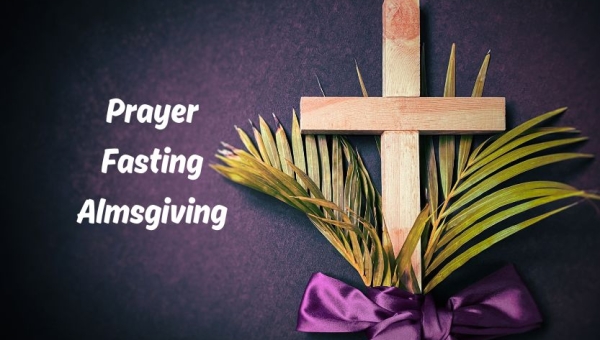
The classical penances are prayer, fasting and almsgiving. These penances help us re-establish and fortify our relationships with God through prayer, with ourselves through fasting and abstinence, with others through almsgiving and forgiving, and with creation through ecological responsibility.

RECONCILIATION

The virtue of penance leads to the Sacrament of Penance or Reconciliation. The virtue of penance entails “The will to receive the Sacrament of the forgiveness of sins,” including, our sins against God, neighbours, the poor neighbour and creation (K. Rahner).

Through God’s gift of Lent, let us continue trying to be more deeply converted, to pray better, and fast to be temperate, and share a little more with the marginalized and excluded in our world – a world that needs our prayer and compassion. Lents calls us to a simple lifestyle.

Lent is a time to change: metanoia, renewal. An inspiring fable from Arabian narratives. The teacher Bayacid told his disciples: When I was young, I wanted to be a revolutionary.  Every night I prayed to God: “Give me courage to change the world.” Nothing happened. When I became an adult, I wanted to change my family and those around me, and I prayed every night: “Lord, help me change those around me, at least my family.” Nothing happened. Now that I am old, I realize how silly I was, and my prayer is: “Lord, give me your grace to change myself.”  He added: “If I had prayed like this, I would not have wasted my life.” And, then, the family began to change.

Lent reminds us that we are dust and in dust we shall return. Yes, but more importantly, Lent leads us to Easter through the passion, death and resurrection of Christ. Through Lent, we do not forget that we are Easter people and alleluia is our song! (FGB)


Holy Rosary Province Spirituality 16 February 2026
ST. THOMAS AQUINAS AND THE POOR ( 3)
Featured

ST. THOMAS AQUINAS AND THE POOR ( 3)


ST. THOMAS AQUINAS AND THE POOR (and 3)

The so-called preferential option for the Poor, or simply, the option for the poor, is a constant teaching in Christian ethics and spirituality. With its ups and downs; in particular its praxis.

Based on the Sacred Scriptures and part of Christian Tradition, the priority of the poor as an essential chapter of theological and social ethics was particularly developed by the Fathers of the Church, especially by St. Basil, St. Ambrose and St. John Chrysostom.  Also, by St. Augustine.

      Among the ecumenical council – generally focused on doctrinal matters -, Vatican II, represents the highest point (cf. Gaudium et Spes). 

The so-called social doctrine of the Church, the social encyclicals of the Popes, starting with Leo XIII’s Rerum Novarum, highlight the primary option of the poor – of laborers - as the priority of justice-love, of charity as love of neighbor.

Pope Leo XIV, in his first lengthy papal document, summaries creatively and develops further, the Christian option or love of the poor. This important and relevant Apostolic Exhortation is entitled Dilexi Te (I have loved you), and subtitled On the love towards the poor (October 4, 2025). It is the only papal document so far centered exclusively on the option, or preferential option, or love for the poor.

In numbers 63-67, Pope Leo XIV speaks of the mendicant orders, founded by St. Francis and St. Dominic, and highlights their members’ witnessing, then (13th century) of evangelical poverty. St. Thomas Aquinas, eminent witness of evangelical poverty, lived and taught the option of the poor - in other words.   

 Among the classical theologians, Thomas Aquinas (1225-1274) stands out. He knows very well the teachings of the Sacred Scriptures and of all the Fathers of the Church. What is the relevant teaching of St. Thomas on the principal love of charity - the poor?

The Angelic Doctor writes: Jesus, “who possessed all, and through whom all things are, became poor, lest anyone, believing in him, would dare to boast of worldly riches.” Pure of heart and sober in eating and drinking. Thomas had a heart of a mother towards the poor.  He loved poverty and was happy with his poor habit and poor pair of shoes. He was very humble as a student, a teacher and a member of the community. He turned down high ecclesiastical positions.

Charity is universal: loves all, and principally the poor and marginalized. Considering that the option involves mainly the virtues of justice and charity, let us look briefly on the corresponding teachings of St Thomas.

The Common Doctor studies justice as one of the four cardinal virtues (with prudence, fortitude and temperance). Justice is a good habit, a social virtue that inclines us to give to each person what is due to him or to her (cf. II-II, q. 58). What is due to the poor?

 The most radical teaching of St. Thomas on the matter is his distinction between common and private property. Common property (community of goods) refers to the natural right of all to have a share in the goods created by God for all, while private property (individual appropriation) refers to the positive right of individuals to own something, but not only for their own use, but also for the use of others who are in real need.

Thomas asks himself: Can man possess external goods? Is it lawful for a person to possess goods as his own?  Is it justifiable for a person-in-need to “steal”?

The Angelic Doctor answers: The possession of external goods is not natural to man with regard to their nature. Why? Because God is their principal owner. (cf. STh II-II, 666,1). With regard to their use and management, yes: man has natural dominion over external goods, over all creatures (cf. Gen 1, 26).

Is it legitimate for individual persons to possess anything as their own? No. Why? Because God created the goods of the earth for all (II-II, 66. 2). However, it is legitimate for man – and even. necessary – to have private property: he takes good care of his own things; human affairs are more efficiently organized if everyone has his own responsibility, and “men live together in greater peace when everyone is content with what is his. Then, the use (administration) of the goods of the earth belongs to man. [The problem: many do not have much, or have little or really nothing!]. Hence, “no man is entitled to have things merely for himself, but for all, so that he is ready to share with others in case of need” (limited ownership).

 Therefore, common property (common use of goods) is by natural law, while private property (individual appropriation) is by positive law. The latter is not contrary to natural law, but an addition to it (II-II, 66, 2, ad 1). The Doctor of Divinity is in favour of private property, but not of a possessive privatizing property. (Thomas accompanied with the teachings on these matters with the Fathers of the Church).

A modern theologian comments: “Private ownership in the matter of the goods of the earth is only secondary and subordinate to common benefit: it exists only as a responsibility and a trust” (Mary O’Driscoll, OP). Like everyone else, the poor have a right to a share in the goods of the earth God created for all. The sharing of goods is a requirement of our faith.

Is theft justifiable in case of necessity? (II-II, 66, 7).  Properly speaking, theft is not just, but a failure of justice, an injustice (cf. II-II, 66, 3 ad 3 1). The answer of St. Thomas to that question: in case of real necessity, everything is in common. In case of of “an evident and urgent need,” it is not theft.

A related question: What about “superfluous goods”? St. Thomas tells us that they belong to the poor: “The superfluous goods that some persons own are due  by natural right to the sustainment of the poor” (II-II, 66, 7). All persons, and principally the rich, are obliged to give to the needy what they do not need, taking into account their state and situation in ife.

We find a clear echo of this radical teaching in the Catechism of the Catholic Church (1992, 1997): The poor in real need may take from the squandering and selfish and over-consuming rich. This taking from them is not really “theft.” Why? “Because the natural order created by God demands that the use of goods is for all” (CCC, 2408). In a similar context, Pope Leo XIV questions us: Are you ready to share the goods of the earth, which belong to all, in a just and equitable manner? (In Unitate Fidei – November 2, 2025 - no. 10).

St. Thomas on laws, justice and charity. On their proper relationships.

Laws and Justice: Laws respect justice.  Human laws ought to be just laws.  Unjust laws are not binding and should not be obeyed. If disobeying a law would be a greater evil, then, should not be disobeyed

Justice and Charity: Justice as mediation of Charity or Love: “All things issue from charity as from a principle, and all things are ordered towards charity as to an end.” No charity without justice.

Charity and mercy. St. Thomas’ words: “Justice without mercy is cruelty; mercy without justice is stupidity.”   St. Thomas Aquinas writes: The noblest deeds are the works of mercy, “even more than our acts of worship”; “Mercy is the beating heart of the Gospel” (Pope Francis, GE, 106 and 97). Almsgiving is an act of merciful charity.    Almsgiving as an addition to justice.

Love of the needy neighbor is the priority, the distinguishing characteristic of all the followers of Jesus, “the great criterion” of holiness also today. It is Christ’s call to all Christians and people of good will: “I was hungry and you gave me food…” (cf. Mt 25:35-36).  

St. Thomas’ teachings on justice, property and the poor influenced much the theologians of Salamanca (16th Century), particularly Francisco de Vitoria, the missionaries in Latin America, headed by Bartolomé de las Casas, and in our time Gustavo Gutierrez of the Theology of Liberation (20th-2firs centuries). Also, the Angelic Doctor has inspired the social doctrine of the Church and papal social encyclicals.

“God intended the earth and all that it contains for the use of every human being and people… (T)he right to have a share of earthly goods for oneself and one’s family belongs to everyone” (GS, 69. Cf. GS, 34; St. Paul VI, PP, 22-24; St. John Paul II, LE, 14, SRS 31 and 42; Benedict XVI, Deus Caritas Est; Pope Francis, Gaudete et Exultate; Pope Leo XIV, Dilexi Te). Cf. St. Thomas Aquinas, STh II-II, 32, 5 ad 2; STh,66, aa. 2 and 7)

In our individualistic and cold world, Thomas Aquinas continues to be light for our hopeful journey to full life.

AND TO CLOSE. Thomas’ Charitable Justice is a call to a simple life-style (no to wasting and squandering), poverty in spirit, and sharing: “Let us live simply so that others may simply live” (FGB)


Holy Rosary Province Spirituality 29 January 2026
 ST. THOMAS AQUINAS:   SOME BASIC RELEVANT TEACHINGS (2)
Featured

ST. THOMAS AQUINAS: SOME BASIC RELEVANT TEACHINGS (2)


ST. THOMAS AQUINAS:  

SOME BASIC RELEVANT TEACHINGS

CHRIST is the center of St. Thomas’ life. The Angelic Doctor says: Jesus, “who possessed all, and through whom all things are, became poor, lest anyone, believing in him, would dare to boast of worldly riches. He did not wish to be made a king, for He pointed out the way of humility. He who fed all, hungered; He, who created all drink, thirsted; He, who opened up the way to heaven, grew tired on his journey; He, who ended our afflictions, was crucified; He, who awakened the dead, died for man” (Quoted by Dr. Martin Grabmann, The Interior Life of St. Thomas Aquinas).

The author of the Adoro te devote writes: “For the love of Jesus Christ I have studied, kept vigil, and struggled; indeed, it was you, Jesus, that I preached and you that I taught.”

      Chesterton writes that “The Angelic Doctor produced books enough to sink a ship or to stock a library.” However, St. Thomas’ writings will not be fully meaningful to us unless we re-encounter in faith the God who inspired him (S. Pinckaers). The Dominicans - with so many others who love him - are obliged to show Thomas’ relevance today. The Angelic Doctor continues teaching us many permanently significant points on God, Christ, creation, the human person, happiness, virtue, grace, love, the Gifts of the Holy Spirit. We are asked to make those points significant for our time, for our world, which is permeated by globalization, technology, relativism, violence, injustice, wars, materialism and consumerism, insensibility towards the poor and different.

The Doctor of Divinity is also a mystic and poet: with St. Albert the Great, he has been called “mystic on campus.”  How could otherwise be able to write the awesome and sublime hymns to the Holy Eucharist? He approached the search of truth – the Truth – intellectually and affectively: through reason and faith; through acquired and infused contemplation; through love as way of knowing. St. Catherine, who always calls St Thomas, il glorioso Tommaso, says in her Dialogue: “The glorious Thomas Aquinas acquired his science more from his dedication to prayer, the elevation of the mind and the light of the intellect than from human study.”  The Angelic Doctor was a contemplative man. In his life, there was no opposition but integration between prayer and study, contemplation and action (cf. STh, II-II, 181, 3).

The Angelic Doctor’s teachings on virtue and private property, for instance, continue fascinating many people today. Virtue ethics is a current paradigm for ethics, bioethics and moral theology. The practice of virtues gives meaning to life, freedom, character, and it makes people happy – and happier: “Happiness consists in the practice of virtue” (Thomas Aquinas). A. Sertillanges says that “learning goes hand in hand with virtue-ing. The Doctor of the Eucharist is an exemplar of intertwined learning and virtue-ing.”

Thomas’ unwavering love for truth - veritas - is truly amazing. He was “veritatis unice amator,” lover of truth solely: Every truth, he wrote, “regardless of who said it, comes from the Holy Spirit”: “Omne verum a quocumque dicatur, a Spiritu Sancto est” (I-II, 109, 1 ad 1).

On love: “All things issue from charity as from a principle, and all things are ordered towards charity as to an end” (In Jn. XV, 2). Love is always the value and the virtue of life, a love or charity that is peaceful, joyful and merciful, and is, as Thomas proves well, the “form” and motor of all virtues.

Two main qualities characterize Aquinas’ writings: clarity and brevity (Cf. Summa Theologiae, STh, I, Prologue). A wonderful exemplar for all. Nowadays, teachers, preachers, writers, leaders, politicians are asked to strive for clarity and brevity in a world overcrowded with empty words, loud noise, “fake news,” and post-truth.

Among his many written works, the Summa Theologiae continues to be the most quoted and studied. What is a Summa Theologiae? It is “a brief, ordered and complete explanation of all and each of the parts of Catholic doctrine” (S. Ramirez). The Summa Theologica is “like the pyramids of Egypt (Lacordaire), like “the ordered columns in the naves of a cathedral” (S. Pinckaers). St. Thomas is a master in theology and above all, in his Summa Theologiae

Some years ago, I read the news that the translation of the Summa in Japanese had been finished: 45 volumes, 20 of them – including the last ones - by philosopher Ryosuke Inagaki who, when asked if the work was difficult, answered: “It was not hard. Thomas’ writing is like a piece of Bach, with a rhythm that makes it easy to approach.” Inagaki himself published a pocket edition of the Summa entitled My Way of Life. Why this title? He answers: “This title really brings out the defining feature of the Summa Theologica. St. Thomas wanted to write a roadmap for people who really and truly seek happiness.” Writes Benedict XVI, who followed mainly the lane of St. Augustine and St. Bonaventure: “In our catechesis on the Christian culture of the Middle Ages, we now turn to St. Thomas Aquinas, known as the Doctor Communis, whose life and teaching have always been revered as an outstanding model for theologians… Among the many commentaries and systematic works, the great Summa Theologiae reveals his critical gifts and his conviction of the natural harmony between faith and reason (Address: June 2, 2010).

The Summa of St. Thomas is divided into parts; parts into questions, and questions into articles. Usually, every question is subdivided into articles (exceptions: I, qq. 71 and 72; II-II, q. 128 and q. 143. See Ceslada, 18).

John XXII canonized Thomas Aquinas on July 18, 1323. The Pope made reference then to the Summa Theologica with these words: It contains “As many miracles as articles.” The Summa has more than three thousand articles.

Let me add another important point! St. Thomas faced the relevant questions of his time in his famous Quaestiones Disputatae (disputed questions), such as questions on evil, truth, virtue, religious life, etc. Today we have to follow – as some are already doing well - Thomas’ practice of facing, from the perspective of reason and faith, the pervading topics of the day. We are asked to answer the questions our contemporaries ask: on the meaning of life, fundamentalism, pluralism and tolerance, dialogue, morality in liberalism and socialism, violence and war, technology and artificial intelligence, transhumanism, new evangelization, happiness and virtue, justice and mercy – charitable justice.

Indeed, Thomas Aquinas, Saint, doctor of the Church, mystic, and poet has much to say today through his writings - on philosophy, theology and spirituality – and with his holy life.

The Angelic Doctor is a saint and, therefore, for him, as for all saints: “Prius vita quam doctrina,” or First life, then doctrine.

After having written 34 volumes in IV “major” and two columns, Thomas had a special encounter with Christ, a vision of God, which prompted the theologian to utter humbly: “All that I have written is straw.” It was on December 6, 1273 during the Mass of St. Nicholas in the Church of St. Dominic in Naples. After this mysterious vision, just a few months before his death, Thomas did not write anything anymore, and even abandoned the instruments of writing. After the intimate encounter with the Word, Thomas kept silent, the contemplative silent love of a mystic: no more words, no more writings, just silence, total silence - the mystic’s sound of silence! (FGB)


Holy Rosary Province Spirituality 26 January 2026
  1. ST. THOMAS AQUINA: MASTER, MISTYC, POET IS HE STILL RELEVANT TODAY?
  2. CHARITY AS MERCIFUL LOVE
  3. CHARITY AS JOYFUL LOVE
  4. CHARITY AS PEACEFUL LOVE

Page 2 of 14

  • 1
  • 2
  • 3
  • 4
  • 5
  • 6
  • 7
  • 8
  • 9
  • 10
© 2026 Holy Rosary Province. All Rights Reserved.
Our Lady of the Rosary Province of the Order of Preachers
  • Home
    • History
    • Provincial Curia
      • Novitiate
      • Studentate
    • Vicariates & Missions
      • Mission in Taiwan
      • Mission in South Korea
      • Mission in Singapore
      • Mission in Timor Leste
      • Mission in Myanmar
      • Vicariate of Philippines
      • Vicariate of Japan
      • Vicariate of Venezuela
      • Vicariate of Spain
  • Officials of the Province
  • Dominican Saints
    • Saint Dominic de Guzman
  • Vocation
    • Religious Life
    • Formation